
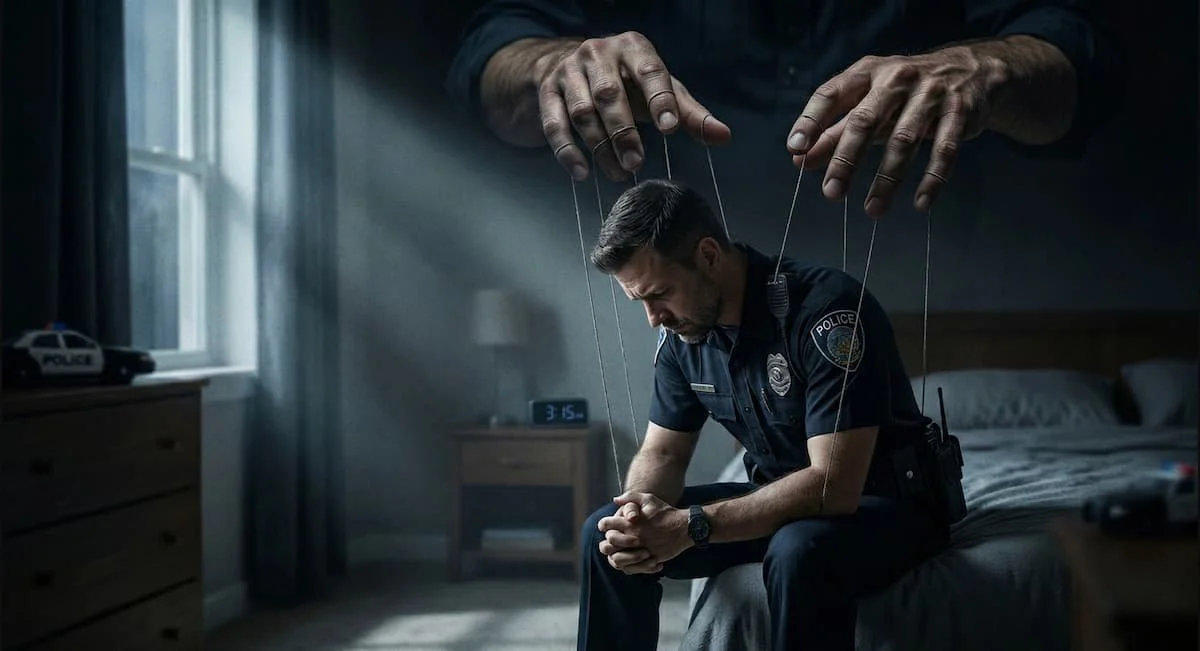
It Doesn't Look Like Trauma. It Looks Like Personality.
There was no single incident. No obvious before and after. No moment you can point to and say that's when everything changed.
It just crept in. Shift after shift, year after year, until one day you looked up and didn't recognize yourself anymore. Or your spouse looked at you and didn't recognize you either.
That's not weakness. That's not a character flaw. That's what prolonged exposure to chronic threat does to a nervous system that was never designed to stay activated forever.
It has a name. It's called Complex PTSD. And most first responders have never heard of it.
PTSD vs. CPTSD: What's the Difference
PTSD develops from a single traumatic event. There is a clear before and after. The nervous system gets stuck at the moment of the incident.
CPTSD develops differently. It comes from prolonged, repeated exposure to threat, exactly the conditions first responders live in every single shift, for years. The nervous system never fully gets the signal that it's safe. It stops returning to baseline. It rewires itself around the assumption that danger is always present.
And here's what makes it so dangerous: it doesn't look like a wound. It looks like personality.
What CPTSD Looks Like in a First Responder
The officer who can't sit still. Who needs the TV loud and the energy high. Who seeks out chaos off duty because calm feels wrong, boring, suffocating, unsafe.
Who is irritable at home but laser-focused on shift. Who is emotionally present for everyone on the job and emotionally unavailable to the people he loves most.
Who chases adrenaline any way he can find it. Driving fast with no seatbelt. Going to calls that aren't even his beat just to get into something. Video games at 2 AM. Drinking. Affairs. Anything that makes him feel alive again.
Who feels great at work and miserable at home.
He doesn't think he has a problem. He thinks this is just who he is now.
His brain does the math: I feel great at work. I feel miserable at home. Must be my wife.
He's not right. But he can't see it yet. Because the most insidious thing about CPTSD is that the person living inside it is usually the last one to recognize it.
What It Looks Like From the Other Side
The spouse is usually the one who seeks help first.
She has been watching him disappear by degrees. Asking if he's okay so many times she stopped asking. Carrying the emotional weight of the entire household while he is physically present but somewhere else entirely.
She has absorbed years of living in proximity to his chronic threat response. Her nervous system learned to brace. To scan. To function under conditions that were never meant to be normal.
She didn't wear the badge. But she carried the weight.
What she is experiencing has a name too: secondary traumatic stress. And it is just as real, just as treatable, and just as deserving of attention as what he is carrying.
Why It Goes Unrecognized
CPTSD is insidious precisely because it doesn't announce itself. There is no incident report. No clear timeline.
Law enforcement culture makes it worse. The same traits that make a good officer, compartmentalization, emotional control, hyperawareness, the ability to suppress fear, are the exact traits that make CPTSD invisible. The coping mechanisms work until they don't. Until they start costing connection. Until the man who protected everyone else can't find his way back to the people who need him most.
It can also be misdiagnosed. His presentation can look like Narcissistic Personality Disorder. Hers can look like Borderline Personality Disorder. Both end up labeled as the problem. Neither gets the help they actually need.
That's why working with a clinician who actually knows this population matters more than most people realize.
How Carol Works With Trauma
Carol specializes in complex trauma and CPTSD in first responders and their families. She is trained in EMDR, one of the most effective evidence-based approaches for trauma treatment.
EMDR works by helping the brain reprocess traumatic memories and the beliefs attached to them. For first responders who have accumulated years of unprocessed experiences, EMDR can reach what talk therapy alone cannot.
But Carol doesn't stop at reprocessing. She works somatically, helping you understand what your body is carrying and why, because for first responders trauma lives in the nervous system long before it shows up in behavior.
She is direct. She will name what is happening. And she will not let you stay comfortable in a story that is costing you your marriage, your health, and your sense of self.
There Is a Way Through
The nervous system that learned to live in chronic threat can learn something different. Not quickly. Not without help. But it can.
CPTSD is treatable. The officer who doesn't recognize himself can find his way back. The marriage that has been slowly hollowed out by something neither person could name can be restored.
But it starts with naming what is actually happening.
If any part of this page felt like someone was finally reading the actual file, that's not a coincidence. This is exactly who we built this for.
Telehealth in California and Tennessee.
[Book a Free Consultation]
Want to understand more?
Read Carol's full breakdown of CPTSD in law enforcement on Love on the Thin Line: The Puppet Master: Why Peace Feels Dangerous for LEOs loveonthethinline.com/blog/puppet-master-cptsd-law-enforcement